Chemical & Biomolecular Engineering

Top 20 Doctoral Program—National Research Council

Faculty

Dr. Patrick Cirino

Associate Professor of Chemical and Biomolecular Engineering

Office Location: S337, Engineering Building 1; Laboratory: S294, Engineering Building 1

Tel: (713) 743-4399 | Fax: (713) 743-4323

Email: pccirino [at] uh [dot] edu

Education

  • Postdoctoral Associate, University of Florida
  • Ph.D., California Inst. of Technology, 2004
  • B.S., Chemical Engineering, Ohio University, 1997

Professional Experience

  • Assistant Professor, Chemical Engineering, Pennsylvania State University, 2004 – 2010
  • Associate Professor, Chemical Engineering, Pennsylvania State University, 2010
  • Associate Professor, Chemical & Biomolecular Engineering, University of Houston, 2011 – present

Courses

  • CHEE 2331, Chemical Processes (Fall Semester)

Research Interests

Nature provides a vast collection of biological systems which have evolved mechanisms to achieve catalysis, regulation, molecular recognition, and energy utilization with incredible efficiency. Our ability to successfully re-design and harness such systems is integral to realizing a future of cost-effective "green" chemistry, renewable fuels and chemicals, bioremediation, and "next-generation" therapeutics.

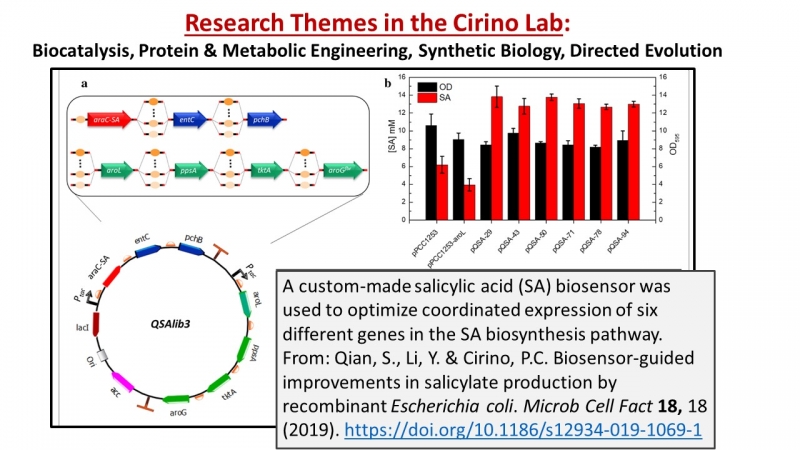
Research in the Cirino laboratory interfaces Chemical Engineering with the biological sciences, with emphases in biomolecular engineering, metabolic engineering, and biocatalysis.  Recent research efforts are summarized in the poster presentations below (right click to view larger images).  By applying biological design principles at the molecular level (e.g., engineer proteins) as well as the systems level (e.g., engineer metabolic pathways and gene regulation) we are creating novel microbial strains with improved biocatalytic efficiency (e.g. increased supply of NADPH to transformations of interest), and we are designing novel biosensors by customizing regulatory proteins, with broad applications in synthetic biology and biocatalyst development.

Metabolic Engineering

Metabolic engineering is defined as the improvement of cellular activities by manipulation of enzymatic, transport, and regulatory functions of the cell with the use of recombinant DNA technology. Current research in our lab is aimed at modifying microbial metabolism to carry out new or improved bioconversions for the production of various secondary metabolites. This typically requires expression of foreign genes in an amenable microbial host (e.g. E. coli).  Several stages of genetic optimization are then required to improve efficiency and productivity.  As strategies to improve strain performance parameters are developed and tested, we gain new insights into microbial metabolism and physiology, further informing the design process.

In one example, we engineer the metabolism of E. coli to create biocatalytic strains which maximize yields on reducing equivalents in the form of NADPH, derived from renewable biomass sugars. This reducing power is subsequently channeled away from aerobic respiration and into driving reactions of interest, such as the reduction of xylose to xylitol (a sweetener and synthetic building block molecule).

In other examples, we are improving flux of precursors metabolites (e.g. acetyl-CoA and malonyl-CoA) toward the synthesis  of secondary metabolites (natural products such as polyketides and isoprenoids) by genetically modified bacteria.  This is largely accomplished via a "directed evolution" strategy in which large numbers of genetic variants are created and screened for improved properties.  This in turn requires high throughput screening of target compounds, which we achieve by creating customized molecular reporters derived from natural regulatory proteins.

Protein Engineering/Molecular Recognition

We are using combinatorial (evolutionary) as well as rational (structure-based) protein design techniques to engineer transcriptional regulatory proteins to serve as customized biosensors. These proteins are being designed to recognize specific non-native molecules of interest ("effectors") and report their presence and concentration by regulating expression of a reporter gene.  Such endogenous biosensors serve as powerful tools in synthetic biology and facilitate subsequent protein engineering and metabolic engineering efforts in our lab and others.

Additional projects include engineering oxygenase enzymes to accommodate new or improved activities, and implementing our custom-designed regulatory proteins in high-throughput screening of novel enzyme and microbial biocatalysts (see above).  All research projects draw from a broad base of knowledge and experimental techniques spanning many disciplines, the common goal being that we use biology to solve problems pertinent to the expanding field of Chemical Engineering.

Computation and modeling contribute to many areas of our research by reducing experimental variables and guiding experimental efforts. Likewise, experimental results can provide information leading to improved biological models. This complementary exchange of information is realized through collaborations with Dr. Costas Maranas at Penn State University.

We gratefully acknowledge the National Science Foundation for numerous grants to support these research projects.


Research Group

Cirino lab members

Post-doctoral associate

  • Dr. Joseph Gredell


Graduate Students

  • Christopher Frei
  • Ye Li
  • Mizan Rahman
  • Bala Ramesh (primary advisor is Dr. Navin Varadarajan)


Former lab members:

Postdocs

  • Dr. Shuang-Yan Tang (now Professor at Kunming University of Science and Technology)
  • Dr. Hui Li


Graduate Students

  • Dr. Olubolaji Akinterinwa (PhD 2010): currently at Procter & Gamble
  • Dr. Jonathan Chin (PhD 2010): currently at Algenol Biofuels
  • Dr. Reza Khankal (PhD 2010): currently at Glycos Biotechnology
  • Dr. Hossein Fazelinia (Ph.D.  2009 co-advised by C.Maranas)
  • Lexan Lhu (M.S.; employed at Joule Biotechnologies, MA)
  • Christopher Frei (M.S. 2010): now a Ph.D. student in Cirino lab
  • Francesca Luziatelli (visiting student from U of Tuscia, Italy)


Lois Eppihimer (lab manager)


PSU Honors College Undergrad Researchers

  • Caroline Monroe
  • Anthony Tascone
  • Renae Patch
  • Garrett Tobin


Other Undergraduate Researchers

  • Oliver Chou (U Colorado Boulder)
  • Kyle Schutter (Brown University)
  • Nicholas Linn (NC State)
  • Berook T. Alemayehu (U Maryland: Baltimore County)
  • Audrey Leung (University of Iowa)
  • Jeremy Sargent (Penn State)
  • J. Lane Weaver (Penn State)
  • Jon P. Badalamenti (Penn State)
  • Lucien E Weiss (Penn State)
  • Julie Sawlsville (Penn State)
  • Geoff Geise (Penn State)
  • Doug Haag (Penn State)
  • Megan Rex (Penn State)
  • Chris Cottle (Penn State)
  • Panagiotis A Papadopoulos (Penn State)
  • Matthew Zapadka (Penn State)
  • Samhita Banavar (PA Governor’s school for high school students)


Work-Study Students

  • Ryan Noraas
  • Tiffany Veet
  • Khai Van
  • John Ajak

Awards and Honors

  • 2006 N.S.F. CAREER Award Recipient
  • Associate Editor: BMC Biotechnology
  • Editorial Board Member: Biotechnology Letters, Biotechnology Journal, Journal of Biological Engineering
  • Guest Editor, “Applications of Synthetic Biology in Microbial Biotechnology”, Journal of Biomedicine and Biotechnology (2009)
  • ACS BIOT 2012 Program Chair
  • SIM Biocatalysis program co-chair, 2010 - 2012

Professional Activities

  • Councilor, Institute of Biological Engineering (IBE), 2006-2010
  • Faculty Advisor, Penn State iGEM Undergrad Research (Synthetic Biology) 2006 - 2009
  • Instructor, Fundamentals of Bioseparation Techniques, Penn State Biotechnology Training Program (2004 - 2010)

Selected Publications

  1. Akinterinwa O and PC Cirino,

    Anaerobic obligatory xylitol production in Escherichia coli strains devoid of native fermentation pathways. Applied and Environmental Microbiology. 77(2):706-9

    , 2011
  2. Tang SY and Cirino PC,

    Design and application of a novel mevalonate-responsive regulatory protein. Angewandte Chemie International Edition. 50(5):1084-6

    , 2011
  3. Chin JW and PC Cirino,

    Improved NADPH supply for xylitol production by engineered Escherichia coli with glycolytic mutations. Biotechnol. Progress, 27(2):333-41

    , 2011
  4. Fasan R, Crook NC, Landwehr M, Cirino PC, and FH Arnold,

    Improved product-per-glucose yields in P450 dependent propane biotransformations using engineered E. coli. Biotechnol Bioeng., 108(3):500-10

    , 2011
  5. Chin JW and PC Cirino,

    Strain engineering strategies for improving whole-cell biocatalysis: engineering Escherichia coli to overproduce xylitol as an example. Nanoscale Biocatalysis: Methods in Molecular Biology, 743:185-203

    , 2011
  6. Cirino PC,

    Metabolic engineering strategies for production of commodity and fine chemicals: Escherichia coli as a platform organism. Manual of Industrial Microbiology and Biotechnology. ASM Press, ISBN: 9781555815127

    , 2010
  7. Tang SY and PC Cirino,

    Elucidating residue roles in engineered variants of AraC regulatory protein. Protein Sci. 19(2):291-8

    , 2010
  8. Khoury GA, Fazelinia H, Cirino PC, and CD Maranas,

    Computationally driven redesign of Candida boidinii xylose reductase for altered cofactor specificity. Protein Sci. 18(10):2125-38. Cover article

    , 2009
  9. Khankal R, Chin JW, Ghosh D, and PC Cirino,

    Transcriptional effects of CRP* expression in Escherichia coli. J. Biol. Eng. 3:13

    , 2009
  10. Fazelinia H, Cirino PC, and CD Maranas,

    OptGraft: A computational procedure for transferring a binding site onto an existing protein scaffold. Protein Sci. 18(1):180

    , 2009
  11. Chin JW, Khankal R, Monroe CA, Maranas CD, and PC Cirino,

    Analysis of NADPH supply during xylitol production by engineered Escherichia coli. Biotechnol. Bioeng. 102(1):209. Spotlight article

    , 2009
  12. Akinterinwa O and PC Cirino,

    Heterologous expression of D-xylulokinase from Pichia stipitis enables high levels of xylitol production by engineered Escherichia coli growing on xylose. Metab Eng. 11(1):48. Cover article

    , 2009
  13. Akinterinwa, O and PC Cirino,

    Catabolism and Metabolic Fueling Processes. In: The Metabolic Pathway Engineering Handbook, ISBN: 9780849339233

    , 2009
  14. Frei CS and PC Cirino,

    Combinatorial Enzyme Engineering. In: Protein Engineering and Design. J.R. Cochran and S. Park, Eds. Publisher: CRC; 1 edition, ISBN-10: 1420076582

    , 2009
  15. Weiss LE, Badalamenti JP, Weaver JL, Tascone AR, Weiss PS, Richard TL, and PC Cirino,

    Engineering motility as a phenotypic response to LuxI/R-dependent quorum sensing in Escherichia coli. Biotechnol Bioeng. 100(6):1251. Spotlight article

    , 2008
  16. Akinterinwa O, Khankal R, and PC Cirino,

    Metabolic Engineering for Bioproduction of Sugar Alcohols. Curr Opin Biotechnol. 19(5):461

    , 2008
  17. Khankal R, Luziatelli F, Chin JW, Frei CS and PC Cirino,

    Comparison between three common Escherichia coli lab strains as platforms for xylitol production. Biotechnol Lett. 30(9):1645

    , 2008
  18. Tang SY, Fazelinia H, and PC Cirino,

    AraC regulatory protein mutants with altered effector specificity. J. Am. Chem. Soc. 130(15):5267

    , 2008
  19. Cirino PC and Sun L,

    Advancing Biocatalysis through Enzyme, Cellular, and Platform Engineering. Biotechnol. Progr. 24(3):515

    , 2008
  20. Khankal R, Chin JW, PC Cirino,

    Role of xylose transporters in Escherichia coli engineered for xylitol production. J. Biotechnol. 134(3-4):246

    , 2008
  21. Fazelinia H, Cirino PC, and CD Maranas,

    Extending IPRO in protein library design for ligand specificity. Biophys. J. 92(6):2120

    , 2007
  22. Badalamenti JP, Weiss LE, Buckno CJ, Richard TL, Weiss PS, and PC Cirino,

    Synthetic Sports: A Bacterial Relay Race. IET Synth. Biol. 1:61

    , 2007
  23. Cirino PC, Chin JW and LO Ingram,

    Engineering Escherichia coli for Xylitol Production from Glucose-Xylose Mixtures. Biotechnol. Bioeng. 95: 1167

    , 2006
  24. Cirino PC and FH Arnold,

    A self-sufficient peroxide-driven hydroxylation biocatalyst. Angew. Chem.-Int. Edit. 42: 3299

    , 2003
  25. Cirino PC, Tang Y, Takahashi K, Tirrell DA and FH Arnold,

    Global Incorporation of Norleucine in Place of Methionine in Cytochrome P450 BM-3 Heme Domain Increases Peroxygenase Activity. Biotechnol. Bioeng. 83: 729

    , 2003
  26. Salazar O*, Cirino PC* (*equal contributions) and FH Arnold,

    Thermostabilization of a Cytochrome P450 Peroxygenase. ChemBioChem. 4: 891

    , 2003
  27. Cirino PC, Mayer KM, and D Umeno,

    Generating mutant libraries using error-prone PCR. Methods Mol Biol. 231: 3

    , 2003
  28. Cirino PC and R Georgescu,

    Screening for thermostability. Methods Mol Biol. 230: 117

    , 2003
  29. Cirino PC and FH Arnold,

    Regioselectivity and activity of cytochrome P450 BM-3 and mutant F87A in reactions driven by hydrogen peroxide. Adv. Synth. Catal. 344: 932

    , 2002
  30. Cirino PC and FH Arnold,

    Protein engineering of oxygenases for biocatalysis. Curr. Opin. Chem. Biol. 6: 130

    , 2002

Editorials / Edited Volumes

  1. Alper H, Cirino P, Nevoigt E, and Sriram G,

    Applications of Synthetic Biology in Microbial Biotechnology. J Biomedicine Biotechnology. Article ID 918391

    , 2010

Patents

  1. Cirino PC and Ingram LO, inventors, Materials and methods for the efficient production of xylitol in E. coli, U.S. Patent Application Serial No. 20070072280. Licensed to BioEnergy International
    09/01/2005
  2. Arnold FH and Cirino PC, inventors. Thermostable peroxide-driven cytochrome P450 oxygenase variants and methods of use. U.S. Patent No. 7,435,570. Licensed to Codexis
    08/11/2004
  3. Cirino PC and Arnold FH, inventors. Peroxide-driven cytochrome P450 oxygenase variants. U.S. Patent No. 7,704,715. Licensed to Codexis
    04/16/2002